
 Del Bailey
Adults need at least 0.8 grams of protein per day for each kilogram of body weight. That is about 56 grams for a 70-kilogram (154-pound) adult. The 2025–2030 Dietary Guidelines for Americans set a higher goal of 1.2 to 1.6 grams per kilogram. Which number fits you depends on your age, activity and health.
Published November 7, 2026.
How many grams of protein per day
Harvard’s Nutrition Source reports the National Academy of Medicine minimum for adults. It is 0.8 grams of protein for every kilogram of body weight per day. That works out to just over 7 grams for every 20 pounds. Harvard’s own examples are about 50 grams for a 140-pound person and about 70 grams for a 200-pound person.
MedlinePlus gives a second way to count, by calories. It says the daily recommended intake for healthy adults is 10% to 35% of total calorie needs. Protein has 4 calories per gram. On 2,000 calories a day, 10% is 200 calories (50 grams) and 35% is 700 calories (175 grams).
I cook most nights, and protein is where the headline and the plate drift furthest apart, usually toward a bigger number. The 0.8 figure is a floor for adults. Treating it as a target is an easy mistake. So is treating the 175-gram calorie ceiling as a goal.
New dietary guidelines protein recommendations
The Dietary Guidelines for Americans, 2025–2030, are dated January 2026. Their section on prioritizing protein foods at every meal lists a serving goal. The goal is “1.2–1.6 grams of protein per kilogram of body weight per day.” They add that you should adjust it to your calorie needs.
The same section asks for high-quality, nutrient-dense protein foods as part of a healthy eating pattern. It names eggs, poultry, seafood and red meat on the animal side. On the plant side it names beans, peas, lentils, legumes, nuts, seeds and soy.
The guidelines text does not mention the 0.8 figure. Harvard’s page still gives 0.8 as the minimum for adults. One is a floor, the other a serving goal. Ask your clinician which applies to you.
Protein per day by body weight
Here is the arithmetic for four body weights. Pounds divided by 2.2 gives kilograms. Kilograms multiplied by the grams per kilogram gives grams per day.
| Body weight | At 0.8 g/kg (Harvard minimum) | At 1.2 g/kg (guidelines low end) | At 1.6 g/kg (guidelines high end) |
|---|---|---|---|
| 55 kg (121 lb) | 55 × 0.8 = 44 g | 55 × 1.2 = 66 g | 55 × 1.6 = 88 g |
| 70 kg (154 lb) | 70 × 0.8 = 56 g | 70 × 1.2 = 84 g | 70 × 1.6 = 112 g |
| 85 kg (187 lb) | 85 × 0.8 = 68 g | 85 × 1.2 = 102 g | 85 × 1.6 = 136 g |
| 100 kg (220 lb) | 100 × 0.8 = 80 g | 100 × 1.2 = 120 g | 100 × 1.6 = 160 g |
These rows are for adults. MedlinePlus notes that protein also supports growth in children, teens and pregnant women. It adds that children and teens may need different amounts by age. If that describes you, ask your clinician for your number.

How much protein do you need per day to build muscle
Neither Harvard’s page nor the Dietary Guidelines gives a separate muscle-building number, and the guidelines text has no protein section for athletes. The nearest published figure is the guidelines goal of 1.2 to 1.6 grams per kilogram. For an 85-kilogram adult, the table above puts that at 102 to 136 grams.
Harvard does add a warning about protein powders. It says they are not regulated by the Food and Drug Administration for safety. They may also contain large amounts of added sugars and calories, so read the label first. If you train hard and want a personal target, a clinician or registered dietitian can set one.
How much protein per day over 60
The Dietary Guidelines say some older adults need fewer calories. They still need equal or greater amounts of key nutrients, and protein is one of them. Eating less while needing the same protein is a reason to give protein foods a place at every meal.
Neither Harvard nor the guidelines gives an age-specific gram figure for people over 60. Harvard lists age as one of several factors, along with exercise level and health conditions, and gives no separate number. The guidelines goal and the 0.8 minimum are the published figures. A clinician can say where in that range you should sit.
How much protein per meal
None of these sources gives a grams-per-meal rule. The Dietary Guidelines only say to prioritize protein foods at every meal. MedlinePlus says essential amino acids do not have to be eaten at every meal. Balance over the full day matters more, it adds.
If you want a rough split, divide by the number of meals. A 70-kilogram adult at 0.8 grams per kilogram needs 56 grams a day, so 56 ÷ 3 is about 19 grams each. At 1.2 grams per kilogram it is 84 ÷ 3, or 28 grams. That is arithmetic, not a published rule.
The table below uses Harvard’s food figures. MedlinePlus counts one ounce of most protein-rich foods as about 7 grams. Eggs and beef also turn up in our post on foods that help you stay well.
| Food | Serving | Protein |
|---|---|---|
| Sirloin steak, broiled | 4 oz | 33 g |
| Sockeye salmon, grilled | 4 oz | 30 g |
| Chicken thigh, no skin | 4 oz | 28 g |
| Ham steak | 4 oz | 22 g |
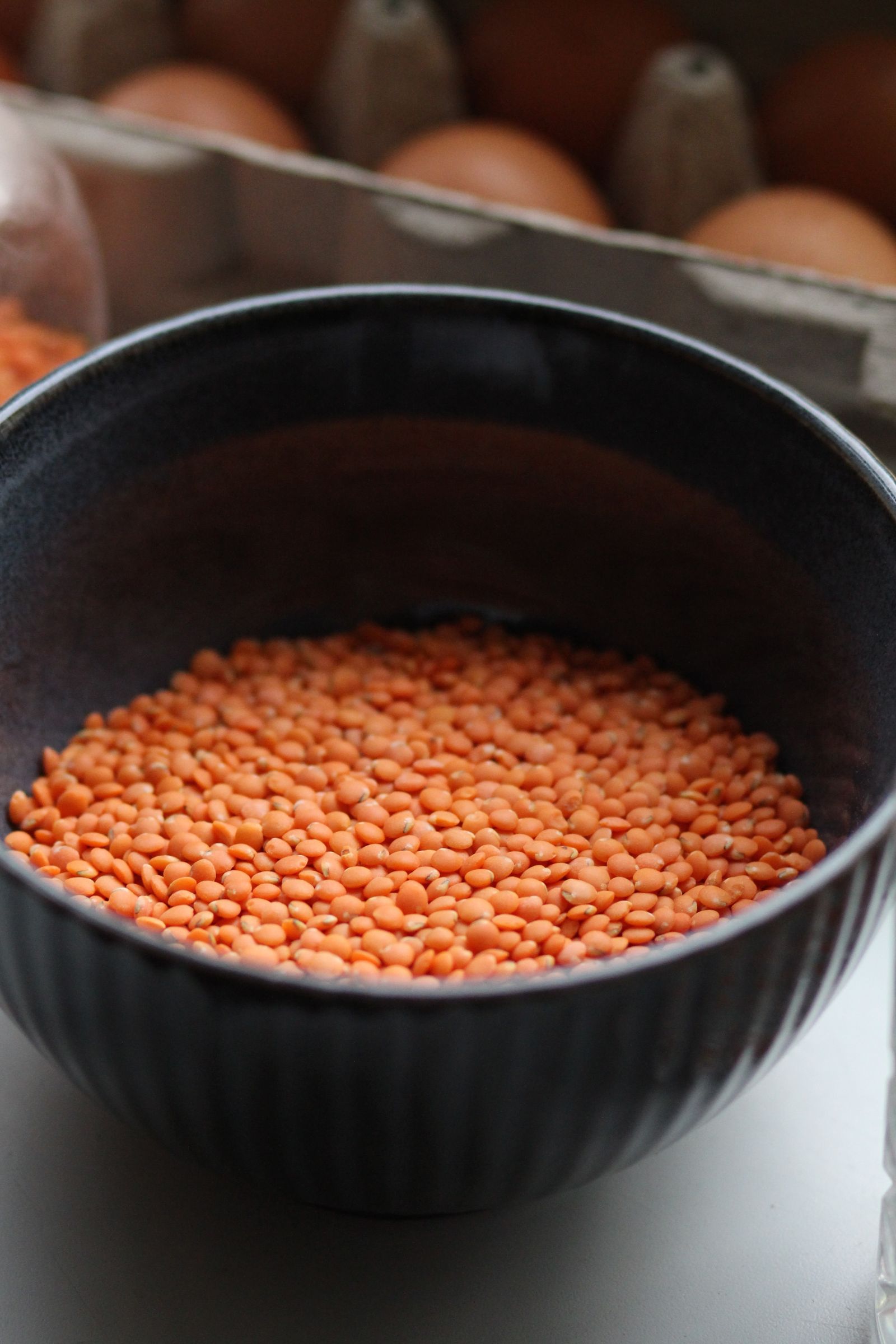
| Lentils, cooked | 1 cup | 18 g |
| Milk | 8 oz | 8 g |
| Almonds, dry roasted | 1 oz | 6 g |
| Egg | 1 large egg, counted by MedlinePlus as 1 oz | about 7 g |
Repeating a few easy meals built around one of these makes the per-meal number less of a chore.
What happens if you eat too much protein
Harvard’s page sets no upper limit and says there is no need to go overboard. It points to the 10% to 35% calorie range and says there is relatively little solid information on the ideal amount.
The bigger issue Harvard raises is what gets crowded out. Some studies show short-term benefits from high-protein, low-carbohydrate diets. Avoiding fruits and whole grains, though, means missing out on their fiber, vitamins and minerals. If you follow a low carb diet, that is the part to watch.
Harvard also says the source matters. In an analysis of more than 130,000 people, the share of calories from protein was not related to overall mortality, while the protein source was. Its advice is to get protein from plants when possible, choose poultry, seafood and eggs over red meat, limit red meat and avoid processed meats.
Is too much protein bad for your kidneys
It can matter for people with kidney disease. The NIDDK, part of the National Institutes of Health, says some people with chronic kidney disease may need to moderate protein. The aim is to keep waste from building up in the blood. It also says too little protein may lead to malnutrition.
The NIDDK page adds that people on dialysis may need more protein, because treatment removes it from the blood. Harvard says people with kidney or liver disease should monitor protein intake according to their physician’s guidelines. Neither page names a harm threshold for adults with healthy kidneys. If you have kidney disease, ask your clinician or a dietitian before you change anything.
Frequently asked questions about protein per day
Is 0.8 grams of protein per kilogram enough?
Harvard’s Nutrition Source calls it the minimum for adults. The 2025–2030 Dietary Guidelines set a higher goal of 1.2–1.6 grams per kilogram per day. Your needs shift with age, exercise level and health conditions, so ask your clinician which number fits you.
How many grams of protein per day should a 150-pound person eat?
Divide 150 pounds by 2.2 to get about 68 kilograms. At 0.8 grams per kilogram that is about 55 grams a day. The Dietary Guidelines goal of 1.2 to 1.6 grams per kilogram gives about 82 to 109 grams.
Can you get enough protein without eating meat?
MedlinePlus says you do not need to eat animal products to meet your protein needs. It lists soy, beans, legumes, nut butters, lentils, tofu, tempeh, nuts and seeds. Harvard notes plant foods often lack one or more essential amino acids, and that mixing plant sources covers the gap.
Does the 1.2 to 1.6 goal replace the 0.8 figure for protein per day?
The Dietary Guidelines text does not mention 0.8 at all. Harvard’s Nutrition Source still describes 0.8 grams per kilogram as the minimum for adults. They are two figures from two sources, so ask your clinician which applies to you.
Should you ask a clinician before changing your protein per day?
If you have kidney disease, the NIDDK says to work with a dietitian or health care professional on the right balance. Some people with the disease need to moderate protein, and too little can cause malnutrition. Harvard gives the same advice for kidney or liver disease. If you are pregnant, or the numbers are for a child or teen, ask your clinician too.
This article is for general information only and is not medical advice. Talk to a licensed clinician about your own situation.

 Jim Owen

 Madeline Marshall