
 Avery Walsh
Calculating body mass index takes one line of math: your weight in kilograms divided by your height in meters squared. For adults, the CDC calls a result from 18.5 to under 25 a healthy weight, 25 to under 30 overweight, and 30 or higher obesity. Think of the number as a quick check, not a verdict.
Updated October 26, 2026.
What a BMI Number Can and Cannot Tell You
I have looked at BMI charts and calculators for years, and the lesson never changes. You get the number fast and it costs nothing, which makes it easy to read too much into it. It comes from just two things, your height and your weight, and it has no idea what that weight is made of. Most of us have stepped on a scale or looked at a chart and wondered what a number really says about us. The honest answer is that it says less than we think.
The CDC calls BMI a quick, low-cost way to screen for underweight, overweight and obesity. It does not measure body fat directly, though it is moderately to strongly linked to measures of body fat. It also cannot tell fat, muscle and bone apart. BMI is a screening tool, not a diagnosis.
Calculating Body Mass Index in Kilograms and Meters
The CDC gives the metric formula as weight in kilograms divided by height in meters squared. Squaring just means multiplying the height by itself.
Say someone weighs 70 kg and stands 1.75 m tall. Multiply 1.75 by 1.75 and you get 3.0625. Then divide 70 by 3.0625. The answer is 22.9, which falls in the healthy range. Anyone who has tried to do that in their head at the kitchen table knows a calculator makes it a lot less painful.
Calculating Body Mass Index in Pounds and Inches
In U.S. units, multiply your weight in pounds by 703, then divide by your height in inches squared. The 703 is a conversion number that makes the pounds-and-inches version match the metric one.
Try a 150-pound adult who is 69 inches tall. 150 times 703 is 105,450. Then 69 times 69 is 4,761, and 105,450 divided by 4,761 is about 22.1. If you would rather skip the math, the CDC lists weights for a 5-foot-9 adult: 125 to 168 pounds is a healthy weight, 169 to 202 is overweight, and 203 or more is obesity.
BMI Ranges for Adults
The CDC uses the same categories for every adult aged 20 and older, no matter their age, sex or race.
| Category | BMI (kg/m²) |
|---|---|
| Underweight | Less than 18.5 |
| Healthy weight | 18.5 to less than 25 |
| Overweight | 25 to less than 30 |
| Obesity | 30 or greater |
| Class 1 obesity | 30 to less than 35 |
| Class 2 obesity | 35 to less than 40 |
| Class 3 obesity (severe) | 40 or greater |
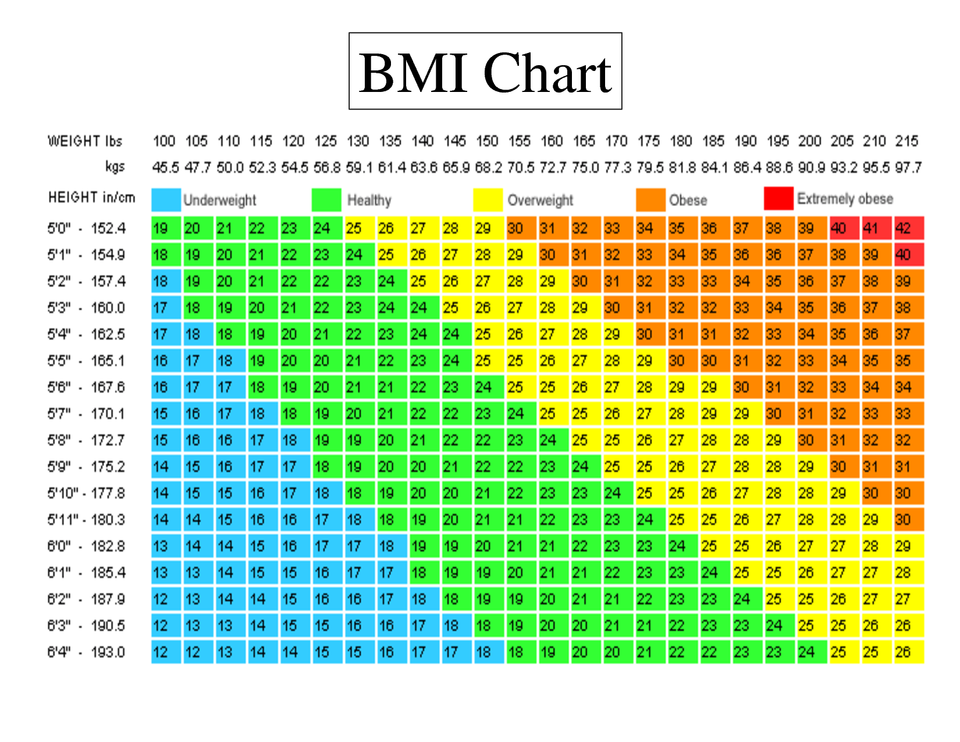
The CDC reports that 41.9 percent of U.S. adults aged 20 and older had obesity during 2017 to March 2020, and 9.2 percent had severe obesity, based on the National Health and Nutrition Examination Survey. It also reports that 58 percent of adults with obesity have high blood pressure and about 23 percent have diabetes.
A number over 30 is not a reason to panic. It is a reason to talk with your doctor about what it means for you. You can also use a chart if you do not like math. Many BMI charts work like a grid: find your height down the left side and your weight across the top, and your BMI sits where the two meet.
BMI for Children and Teens
For ages 2 through 19, the CDC does not use fixed cutoffs. It compares a child’s BMI with percentiles for other kids of the same sex and age. Underweight is below the 5th percentile, healthy weight runs from the 5th to below the 85th, overweight from the 85th to below the 95th, and obesity starts at the 95th percentile.
The American Academy of Pediatrics recommends a BMI check every year starting at age 2, using the CDC growth charts. A pediatrician reads those charts along with the child’s growth history, which a single calculator result cannot do.
Where BMI Falls Short
Because BMI cannot tell fat from muscle, a muscular adult can land in the overweight range without carrying extra fat. Most of us know someone who is built solid from sports or lifting, and a chart does not know that either. The CDC says BMI should be looked at along with other factors when judging one person’s health. Anyone who has ever judged a movie by its star rating knows one number never tells the whole story.
One easy second check is waist size. The National Heart, Lung, and Blood Institute (NHLBI) says a waist of more than 35 inches for women or more than 40 inches for men raises the risk of heart disease and type 2 diabetes. To measure, stand up, wrap a tape around your middle just above the hip bones, and read it right after you breathe out.
So use BMI the way you would use a quick look at the weather. It helps, but it is not the whole forecast. If your number has you thinking about small changes, a few simple daily habits are an easy place to start.
BMI Calculation Questions
How do you calculate BMI?
Divide your weight in kilograms by your height in meters squared. In pounds and inches, multiply your weight by 703 and divide by your height in inches squared. A 70 kg adult who is 1.75 m tall works out to a BMI of 22.9, which falls in the healthy range.
What is a healthy BMI for adults?
The CDC defines a healthy weight as a BMI from 18.5 to less than 25. A result of 25 to less than 30 is overweight, and 30 or higher is obesity. The same adult categories apply regardless of age, sex or race, so ask a health care provider how your own number fits.
Is BMI accurate for athletes?
Not reliably. The CDC says BMI cannot tell fat, muscle and bone apart, so a muscular person can score in a higher category without extra body fat. BMI is a screening tool, so look at it along with other things such as waist size and what a health professional says.
How is BMI measured in children?
For ages 2 through 19, BMI is plotted as a percentile for the child’s sex and age on CDC growth charts. The 5th to below 85th percentile is healthy weight, and the 95th percentile or higher is obesity. The American Academy of Pediatrics recommends checking it yearly from age 2.
What waist size signals higher health risk?
The NHLBI says more than 35 inches for women and more than 40 inches for men raises the risk of heart disease and type 2 diabetes. Measure standing, with the tape just above the hip bones, right after you breathe out.
This article is for general information only and is not medical advice. Talk to a licensed clinician about your own situation.


 Richard Hollis

 Madeline Marshall